CRASH
Government-backed Consumer Rating and Assessment of Safety Helmets. Its model pages publish separate protection and comfort stars, including impact and oblique testing. Results are for Australian-market helmets. Explore CRASH helmet results ↗
Helmet Safety · Standards · Technology
This website has been created to educate you as a consumer when buying a helmet, by providing you with all of the information you need to make the correct purchase. Primarily aimed at motorcyclists, it also covers helmets for cyclists.
All information published on this site has been obtained from people in the helmet industry and publicly available sources. We have not been sponsored or contracted to provide this information by any manufacturer, marketing company, or testing facility. Any opinions or recommendations are our own. Standards and buying guidance were last reviewed in September 2026.
The Problem
When a helmet is sold, or even displayed by a retailer, there is no legal requirement to let the consumer know how well a helmet performs. If everyone buying a helmet bought the one offering the highest level of protection, many more lives would be saved.
The UK's SHARP scheme provides model-specific motorcycle-helmet performance ratings, but retailers have no obligation to display them. Its current star calculation incorporates results from oblique surface-friction tests, although the published protocol does not directly score measured headform rotational acceleration or velocity.
All of this needs to change.
Photo credit: Tom Sykes crashing at Thruxton — a powerful reminder that a crash can happen to anyone, at any speed. The helmet you choose matters.
Mechanics
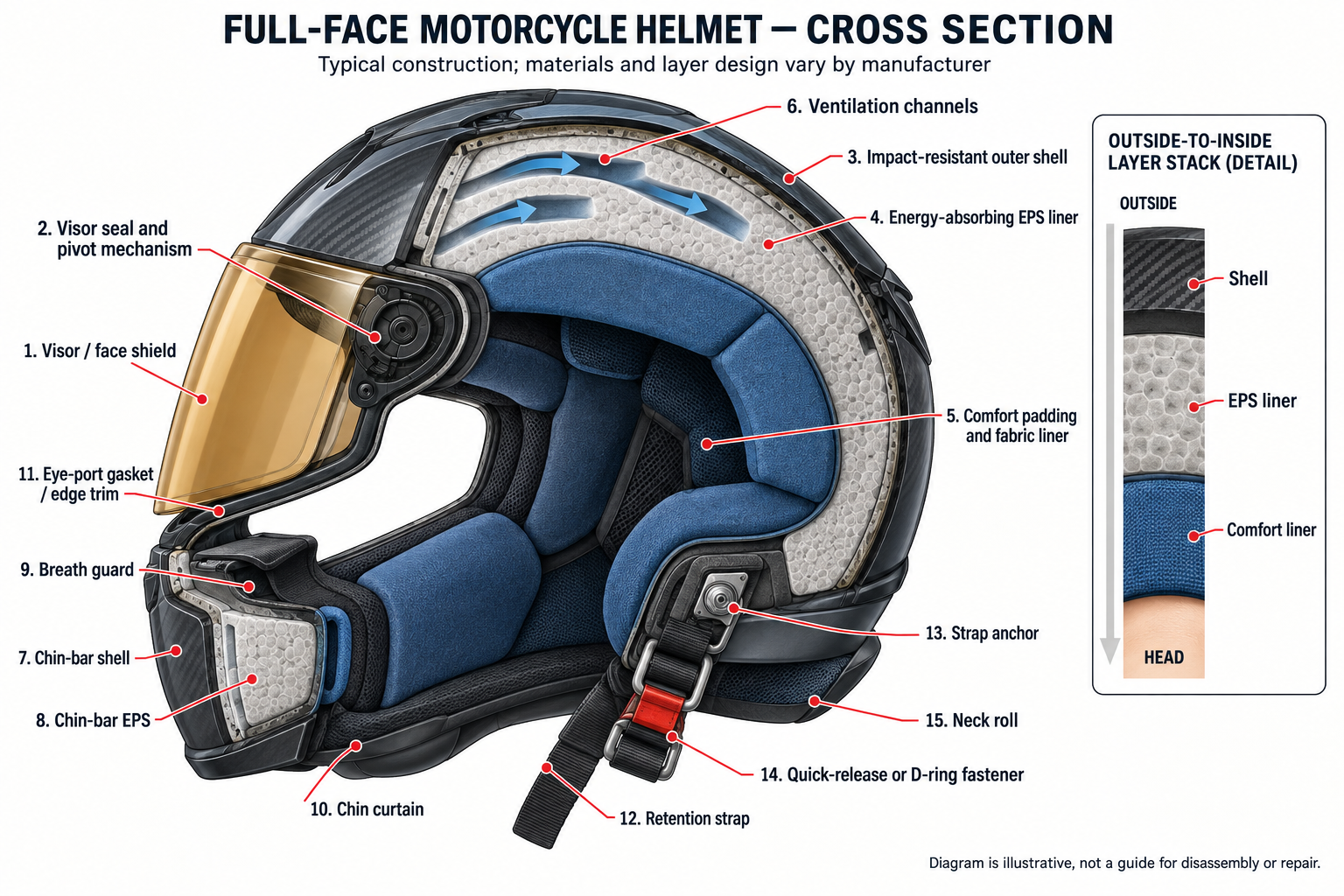
A traditional helmet consists of three layers. From the outside: the shell (visible outer layer), the EPS (expanded polystyrene) layer, and the comfort liner — the padded inside. More modern helmets feature layers of differing-density EPS, and some add a fourth layer to handle rotational forces.
As the helmet impacts, the outer shell spreads the force over a wider area, distributing it across the EPS layer. The EPS then absorbs and disperses the impact energy — reducing the peak acceleration force your head experiences because it decelerates over a longer time. This hopefully keeps your brain from slamming into the inside of your skull.
Slow your head too quickly (EPS too hard) → deceleration forces become injurious or lethal. Not slow enough (EPS too soft) → your skull effectively hits the outer shell. The EPS is the magic that saves lives — but not all EPS layers are equal.
It's worth noting that the exterior shell also plays a vital role: it needs to work with the EPS layer. Shells can be too thick, too hard, too thin or too soft in any given circumstance, so manufacturers try to cover a broad range which means it might not be optimal under all specific circumstances.
Brain Science
Diffuse axonal injury (DAI) is associated with rapid acceleration and deceleration that strains white-matter tracts. Rotational motion is especially important in the injury mechanism, but the forces, direction and duration all matter; a crash motion alone cannot diagnose DAI.
DAI ranges in severity and is a clinical diagnosis. Severe cases can cause prolonged unconsciousness and major disability. See the NCBI clinical overview.
ECE 22.06, the FIM FRHPhe standards and Snell M2025D/M2025R include oblique-impact testing to assess rotational response. These tests assess helmet performance without prescribing a particular branded technology. See the standards comparison for ECE 22.06, the original FIM FRHPhe-01 and its successor FRHPhe-02.
Innovation
Helmet makers use a range of construction and slip-layer approaches to manage linear and rotational motion. The examples below describe design concepts and manufacturer claims; a technology name alone does not establish how a particular helmet performs in independent testing.
Invented by physicist Don Morgan, this uses interlocking cones of different-density EPS. As the cones crush, their resistance changes through the impact. Read the developer's description at Conehead Helmets.
Brands using Conehead: Kali, Head, Scott Sports SA, Mammut, Cannondale, POC, Triple Eight, Fly Racing, Acerbis, Leatt, Foxhead and more.
Some helmets mould the EPS liner directly into the outer shell instead of assembling the parts separately. Kali markets its version as Composite Fusion; performance should still be judged model by model.
Claimed to be present in Shark helmets — borrowing from automotive safety engineering. The idea is that like a modern car, the helmet structure progressively absorbs impact energy. No supporting technical data appears to be publicly available from Shark on how this is implemented.
A low-friction layer between the comfort liner and EPS layer. In a collision, it allows the helmet to slide independently around your head — reducing the rotational energy transmitted to the brain. Best understood by visiting the MIPS protection website.
Another Kali Protectives invention — the Low Density Layer. Similar in goal to MIPS but vastly different in design. It's more than just a slip layer; it offers reduction in both rotational and linear forces. Read real-world data on Pinkbike →
Arai's claim is that by making helmets smoother and rounder, the helmet glances off an object rather than digging in, lowering the coefficient of friction. This would only benefit oblique impacts. Any change in velocity due to the glance still results in acceleration — and there doesn't appear to be any data publicly available to support the effectiveness of this approach.
Safety Certification
Standards reviewed September 2026. This is a selected comparison, not an exhaustive list of every national approval route. See independent helmet ratings for model-by-model comparisons.
Terminology: g = g-force. The conventional standard acceleration of gravity is 9.80665 m/s²; actual local gravitational acceleration varies slightly.
Helmet approval involves a series of tests, not a single g-force threshold. Impact speed, anvil shape, impact location and the measures used all matter when comparing results. The figures below describe laboratory tests, not a safe crash speed or a guarantee against injury.
ECE 22.06 is the 06 series of UN Regulation No. 22 for motorcycle helmets and visors. FIM FRHPhe-02 adds competition homologation on top of an accepted helmet certification. Both assess rotational response through oblique impacts.
Road approval and racing eligibility are separate checks. In Great Britain, government guidance recognises both ECE 22.05 and ECE 22.06 for road use; the newer standard does not itself make an existing 22.05 helmet illegal to wear. See the official helmet guidance, and check your event's rules before riding on track.
Snell designations identify certification standards, rather than star ratings. Check the exact version on the helmet's certification label against Snell's certified helmet lists. A Snell mark does not automatically establish compliance with another standard or eligibility for a particular event.
Sources: FIM FRHPhe-02 Homologation Manual, August 2025 (PDF) · Technical comparison (PDF) · FIM homologated helmets
Source: FIM: history of FRHPhe-01 and introduction of phase 2
Sources: UN Regulation No. 22, 06 series · FIM comparison of ECE and FIM tests (PDF) · SHARP: approval and assessment
Sources: 49 CFR 571.218 · NHTSA consumer guidance
Source: UK government helmet guidance
Source: FIM FRHPhe-02 Homologation Manual, August 2025 (PDF)
Source: NSW Government helmet guidance
Sources: Bureau of Indian Standards · Quality Control Order (PDF)
Sources: Snell M2025D standard (PDF) · M2025 explanatory cover (PDF)
Sources: Snell M2025R standard (PDF) · M2025 explanatory cover (PDF)
Source: Snell M2020 standard (PDF)
Source: Snell M2020 standard (PDF)
Source: Snell M2015 standard (PDF)
Source: Snell M2010 standard (PDF)
Sources: ACU helmet-sticker Q&A · ACU helmet-sticker announcement
General-purpose, discipline-specific and regional routes are not interchangeable. Match the helmet's certification to the activity and local rules. Snell lists B2024 and BE2024 under Draft Snell Standards; the proposed requirements are included below for comparison but are not final certification standards. See the official standards index.
Sources: BSI catalogue entry · EN 1078 text (PDF)
Source: Standards Australia
Sources: Snell B2024 draft, 27 November 2023 (PDF) · Snell standards index
Sources: Snell BE2024 draft, 14 November 2023 (PDF) · Snell standards index
Source: Snell B-90A standard (PDF)
Source: Snell time-trial addendum (PDF)
Use approval as a starting point.
ECE 22.06 and FIM FRHPhe-02 expand the impact testing covered by their predecessors. Passing an approval standard is not a ranking of every helmet that passes it, and racing homologation serves a different purpose from road approval.
Check the certification, fit and condition of the specific helmet. Use independent helmet ratings, where available, to compare tested models, and confirm the required homologation with your race or track-day organiser.
Model-by-model comparison
Buying Advice
The million dollar question — but if you've read through all of the above, you're beginning to realise it's not that simple.
No brand name establishes the performance of every model it sells. Compare the exact helmet's certification, intended use, independent test result where available, fit and condition. Marketing claims about materials or named technologies are not substitutes for model-specific evidence.
Check the exact model and size against the organiser's current approval rules before buying. For ACU events, confirm the model appears on the applicable approval list and carries the required valid sticker.
Buying a new helmet is difficult. There are so many options and price gaps between upper and lower ends can be as much as £800.
Professional sponsorship and replica graphics do not establish that a retail helmet has the same construction or performance as race equipment. Check the certification label and independent result for the exact retail model.
Comfort and fit matter because they affect whether the helmet sits securely and can be worn correctly. Visibility, noise and ventilation also matter to usability, but they do not replace impact protection evidence.
For UK motorcycle helmets, SHARP provides an independent comparison for tested models. A missing SHARP result means the model has not been rated by the scheme; it is not a pass or fail.
A helmet should make firm, even contact around your head and stay in place when you move or try to roll it, without pressure points, pain or red marks. Fasten the strap and wear it for several minutes before deciding. Follow SHARP's fit guide and the manufacturer's instructions.
Price alone is not a reliable measure of protection: lower-priced helmets can achieve high independent ratings, while price may also reflect finish, weight, noise control or features. Compare the exact model's certification and test results, then choose the one that fits correctly and suits the intended use.
Resources
Get In Touch
Have a question, found an error, or want to contribute information? We'd love to hear from you.
About this site
Crash Hats was created to educate motorcycle and cycling helmet buyers. All information is sourced from people in the helmet industry and publicly available research.
We have no commercial relationships with any helmet manufacturer, marketing company, or testing facility. All opinions are our own.
Find the SHARP database at sharp.dft.gov.uk to check ratings for specific helmets.